


Page 5 - Volume 1
P. 5
History of the Kimihia district


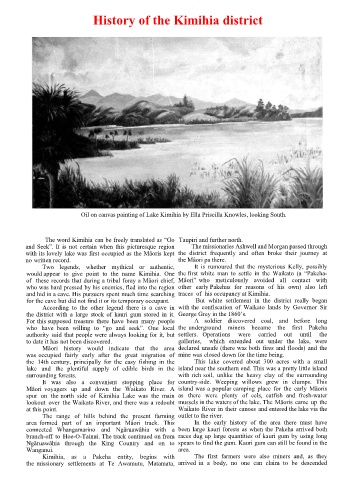
                             Oil on canvas painting of Lake Kimihia by Ella Priscilla Knowles, looking South.


                         The word Kimihia can be freely translated as “Go  Taupiri and further north.
          and Seek”. It  is  not  certain  when  this  picturesque  region                   The missionaries Ashwell and Morgan passed t hrough
          with its lovely lake was first occupied as the Mâoris kept  the  district  frequently  and  often  broke  their  journey  at

          no written record.                                    the Mâori pa there.
                Two  legends,  whether  mythical  or  authentic,     It  is  rumoured  that  the  mysterious  Kelly,  possibly
          would appear  to  give  point  to  the  name  Kimihia.  One  the first  white  man  to  settle  in  the  Waikato  (a  “Pakeha-
          of  these records that during a tribal foray a Mâori chief,  Mâori”  who  meticulously  avoided  all  contact  with
          who was hard pressed by his enemies, fled into the region  other  early Pakehas  for  reasons  of  his  own)  also  left
          and hid in a cave. His pursuers spent much time searching  traces  of  his occupancy at Kimihia.
          for the cave but did not find it or its temporary occupant.   But  white  settlement  in  the  district  really  began
                According  to  the  other  legend  there  is  a  cave  in  with the  confiscation  of  Waikato  lands  by  Governor  Sir
          the district  with  a  large  stock  of  kauri  gum  stored  in  it.  George Grey in the 1860’s.
          For this supposed  treasure  there  have  been  many  people   A  soldier  discovered  coal,  and  before  long
          who  have  been  willing  to  “go  and  seek”.  One  local  the  underground  miners  became  the  first  Pakeha
          authority  said  that people were always looking for it, but  settlers.  Operations  were  carried  out  until  the
          to date it has not been discovered.                   galleries,  which  extended  out  under  the  lake,  were
                Mâori  history  would  indicate  that  the  area  declared unsafe (there was both fires  and floods) and  the
          was occupied  fairly  early  after  the  great  migration  of  mine was closed down for the time being.
          the  14th century,  principally  for  the  easy  fishing  in  the   This  lake  covered  about  300  acres  with  a  small
          lake  and  the  plentiful  supply  of  edible  birds  in  the  island near the southern end. This was a pretty little island
          surrounding forests.                                  with rich soil,  unlike  the  heavy  clay  of  the  surrounding
                It  was  also  a  convenient  stopping  place  for  country-side.  Weeping  willows  grew  in  clumps.  This
          Mâori  voyagers  up  and  down  the  Waikato  River.  A  island was a popular camping  place  for  the  early  Mäoris
          spur  on  the north  side  of  Kimihia  Lake  was  the  main  as  there  were  plenty  of  eels,  catfish  and  fresh-water
          lookout  over  the Waikato River, and there was a redoubt  mussels in the waters of the lake. The Mäoris came up the
          at this point.                                        Waikato River in their canoes and entered the lake via the
                The  range  of  hills  behind  the  present  farming  outlet to the river.
          area  formed  part  of  an  important  Mâori  track.  This   In  the  early  history  of  the  area  there  must  have
          connected  Whangamarino  and  Ngâruawâhia  with  a  been large kauri forests as when the Pakeha arrived both
          branch-off  to  Hoe-O-Tainui. The track continued on from  races dug up large quantities of kauri gum by using long
          Ngâruawâhia  through  the  King  Country  and  on  to  spears to find the gum. Kauri gum can still be found in the
          Wanganui.                                             area.
                Kimihia,  as  a  Pakeha  entity,  begins  with       The  first  farmers  were  also  miners  and,  as  they
          the missionary  settlements  at  Te  Awamutu,  Matamata,  arrived  in  a  body,  no  one  can  claim  to  be  descended

