


Page 6 - Volume 1
P. 6
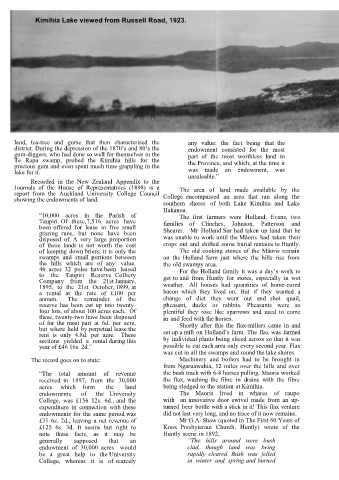
Kimihia Lake viewed from Russell Road, 1923.


      land,  tea-tree  and  gorse  that  then  characterised  the   any  value:  the  fact  being  that  the
      district. During the depression of the 1870’s and 80’s the   endowment  consisted  for  the  most
      gum-diggers, who had done so well for themselves in the      part  of  the  most  worthless  land  in
      Te  Rapa  swamp,  probed  the  Kimihia  hills  for  the      the Province, and which, at the time it
      precious gum and even spent much time grappling in the       was  made  an  endowment,  was
      lake for it.
                                                                   unsaleable.”
                 Recorded  in  the  New  Zealand  Appendix  to  the
      Journals  of  the  House  of  Representatives  (1898)  is  a   The  area  of  land  made  available  by  the
      report  from  the  Auckland  University  College  Council   College  encompassed  an  area  that  ran  along  the
      showing the endowments of land:
                                                          southern  shores  of  both  Lake  Kimihia  and  Lake
                                                          Hakanoa.
               “10,000  acres  in  the  Parish  of              The  first  farmers  were  Holland,  Evans,  two
               Taupiri. Of  these, 7,516  acres  have     families  of  Clinches,  Johnson,  Patterson  and
               been offered  for  lease  in  five  small   Shearer.  Mr  Holland Snr had taken up land that he
               grazing  runs,  but  none  have  been
               disposed  of. A  very  large  proportion   was unable to work until the Mâoris  had  taken  their
               of  these  lands is  not  worth  the  cost   crops  out  and  shifted  some  burial remains to Huntly.
               of  keeping  down briers; it is only the         The  old  cooking  stones  of  the  Mäoris  remain
               swamps  and  small  portions  between      on  the Holland  farm  just  where  the  hills  rise  from
               the  hills  which  are  of  any  value.        the old swampy area.
               46  acres  32  poles  have been  leased          For the Holland family it was a day’s work to
               to  the  Taupiri  Reserve  Colliery        get to and  from  Huntly  for  stores,  especially  in  wet
               Company  from  the  21st January,
               1895,  to  the  21st  October, 1899, at    weather.  All  houses  had  quantities  of  home-cured
               a  rental  at  the  rate  of  £100  per    bacon  which  they  lived  on.  But  if  they  wanted  a
               annum.    The  remainder  of  the          change  of  diet  they  went  out  and  shot  quail,
               reserve  has  been  cut  up  into  twenty-  pheasant,  ducks  or  rabbits.  Pheasants  were  so
               four lots, of about 100 acres each.  Of    plentiful  they  rose  like  sparrows  and  used  to  come
               these, twenty-two have been disposed       in and feed with the horses.
               of  for  the  most part  at  6d.  per  acre,     Shortly  after  this  the  flax-millers  came  in  and
               but  where  held  by perpetual lease the
               rent  is  only  4.8d.  per  acre.  These   set up a mill on Holland’s farm. The flax was farmed
               sections  yielded  a  rental during this   by individual plants being sliced across so that it was
               year of £46 16s. 2d.”                      possible to cut each area only every second year. Flax
                                                          was cut in all the swamps and round the lake shores.
            The record goes on to state:                        Machinery  and  boilers  had  to  be  brought  in
                                                          from Ngaruawahia, 12 miles over the hills and over
               “The  total  amount  of  revenue           the bush track with 6-8 horses pulling. Maoris worked
               received  in  1897,  from  the  30,000     the flax, washing  the  fibre  in  drains  with  the  fibre
               acres   which  form    the    land         being sledged to the station at Kimihia.
               endowments    of    the  University              The  Maoris  lived  in  whares  of  raupo
               College,  was  £156  12s.  6d., and  the   with  an innovative  door  swivel  made  from  an  up-
               expenditure  in  connection  with these    turned  beer  bottle with a stick in it! This flax venture
               endowments for the same  period was        did not last very long, and no trace of it now remains.
               £31  6s.  2d., leaving  a  net revenue of        Mr G.A. Shaw (quoted in The First 60 Years of
               £125  6s.  3d.  It  seems  but  right  to   Knox  Presbyterian  Church,  Huntly)  wrote  of  the
               note  these  facts,  as  it  may  be       Huntly scene in 1892,
               generally   supposed    that    an                  “The  hills  around  were  bush
               endowment  of  30,000  acres  would                 clad,  though  land  was  being
               be  a  great  help  to  the University              rapidly  cleared. Bush  was  felled
               College,  whereas  it  is  of scarcely              in  winter  and  spring and burned

