


Page 7 - Volume 1
P. 7
Most    buildings   were  miners’            married Margaret Muir and had a family of 14 children.
                    cottages of three to four rooms. New
                    arrivals  sometimes  lived  in  Māori                   Before the turn of the century it became apparent
                    whares.”                                     that a  local  school  was  necessary  to  cater  for  the
                                                                 increased  juvenile  population,  the  result  of  closer
                  In  those  early  days  Kimihia  boasted  a  railway  settlement.
            station,  a  shop  and  a  boarding  house  (this  railway   A  petition  was  presented  by  some  of  the  local
            station  was  situated  where  Kimihia  Road         settlers  to  the  Auckland  Education  Board  for  such  a
            originally  intersected  with    State  Highway  1,   school.
            off Hakanoa Street). One of the houses acted as a         At the time the children who were old enough to
            post  office.  Family  names  listed  in  the  Kimihia  Sixty  stand  the  rigors  of  the  daily  return
            Years booklet are some which are still in Huntly today -  journey had to tramp over the old
            names like, McGlynn,  Evans,  Soppet,  Troughear,  swamp  road  to  Huntly  school,
            Clinch,   Hall,  Skellern,  Taylor,  Dunn,  Patterson,  which had opened in 1879.
            Foote,  Johnson,  Wilson,  Russell,  Holland  and                            In   due   course   the
            Valentine.                                           Education  Board  agreed  to
                  Most  of  the  land  on  the  east  side  was  obtained  provide  a  school  and  a  site
            from the  Māori  people  in  the  early  1870’s  and  given  was  selected  on  part  of  a
            or sold to soldiers who had taken part in the land wars.     University  endowment as indicated  in
                                      From  this  time  until  the  1900’s  it  was  mainly  the following letter:
            owned  by  the  Ralph  and  Muir  families.  Robert  Riley          (continued  on page 16)
            Ralph,  son  of  Anthony,  the  first  settler  in  the  district,


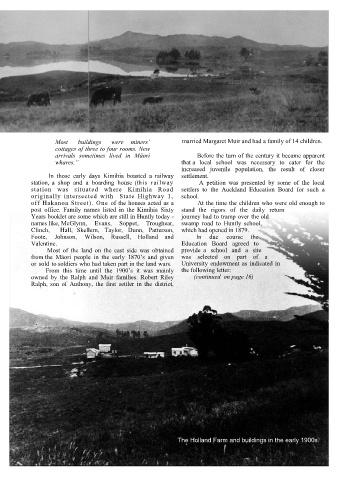
                                                               The Holland Farm and buildings in the early 1900s.

